
Riding the New York Subway with Kids: Fares, Signs, Strollers and Safety
For most kids, the subway is part of the adventure: trains roaring in, maps to read, a stop to count down to. It's also the quickest way around New York. Here's how paying works now, which children ride free, how to read the signs, and how to manage with a stroller.
Fares and rules change from time to time; these were checked on the MTA's official website in October 2026.
Paying with OMNY
The subway runs on OMNY: tap a contactless bank card, a phone or watch with a digital wallet, or an OMNY card on the reader at the turnstile. The fare is $3 a ride on the subway and local buses, with one free transfer within two hours (subway to bus, bus to subway, or bus to bus).
MetroCards can no longer be bought or refilled, so visitors don't need one. If you'd rather not use a bank card, OMNY cards are sold from vending machines in stations and at many shops.
- The weekly fare cap: once one card or device has paid $35 in a 7-day period, the rest of that period's subway and local bus rides on it are free. Your first tap starts the seven days.
- Tap the same way every time. A bank card and the same card in your phone's wallet count as different payment methods, each with its own cap.
- One card per paying rider works best. You can tap the same card again for someone else, but only your own first tap counts toward the cap, and extra taps are always charged the full fare. Give each paying adult or older child their own card or phone.
Which kids ride free
- Up to three children under 44 inches (112 cm) tall ride free on the subway and most local buses with a fare-paying adult. They don't need to tap.
- Taller children pay the regular fare, the same as adults. Reduced fares are for seniors and people with qualifying disabilities.
- Express buses are different: only children under 2 riding on an adult's lap go free.
- Measure before you go if your child is close to the line; it saves an argument at the turnstile.
Reading the signs
- Trains have a letter or a number, shown in a coloured circle. The colour shows the line it shares in Manhattan, so check the letter or number, not just the colour.
- Uptown means north, downtown means south in Manhattan. Some stations have separate entrances for each direction, so read the sign above the stairs before you tap in.
- Local or express? Express trains skip stops. On the map, local-only stops are black dots and express stops are white. When in doubt, take the local.
- Watch the platform signs for which trains stop there, and listen for announcements: weekend and late-night service changes are common. The MTA app shows them before you set off.
- Give kids a job: counting down the stops or spotting your station's name on the wall keeps them busy and helps you get off at the right place.
Strollers
Strollers are fine on the subway, but many stations have stairs only. The MTA's advice is to fold the stroller and carry your child on stairs and escalators, and to use elevators where you can.
- Plan step-free routes: accessible stations are marked with the wheelchair symbol on the map. Check the MTA's elevator and escalator status page or app before you go, because elevators do break down.
- Use the AutoGate where there is one: many accessible stations have these wide gates for riders with strollers or large luggage.
- Board in the middle of the train, where the conductor usually is, and keep the stroller out of the doorway.
- Crowded car? Fold the stroller if you can, and avoid rush hours when possible.
- Buses are step-free: the MTA is adding an area for one open stroller near the rear door of every bus by the end of 2026. If it's taken or your stroller doesn't fit, fold it.
- A light stroller plus a baby carrier is the easiest combination for a subway day. See our NYC with toddlers guide.
Safety
- Stand back from the platform edge, especially when trains are coming in or leaving. Hold small hands on the platform and on stairs.
- Never go onto the tracks, for any reason, even for a dropped toy or phone. Tell station staff.
- Agree a plan in case you're separated: if a child is left on the train or the platform, the parent on the train gets off at the next stop and everyone meets there. Older kids should know your phone number.
- Help Points: the blue intercoms in stations have a red emergency button and a green information button. For a crime in progress, call 911.
- At night, ride in a busier car, near other passengers.
Subway etiquette for kids
- Let people off before you get on, then move into the middle of the car.
- Never hold the doors. It delays the train, and doors can close on fingers and stroller wheels.
- One seat per person, bags on laps or the floor, and offer seats to people who need them more.
- Keep passageways clear, including with scooters and strollers.
Make it a game
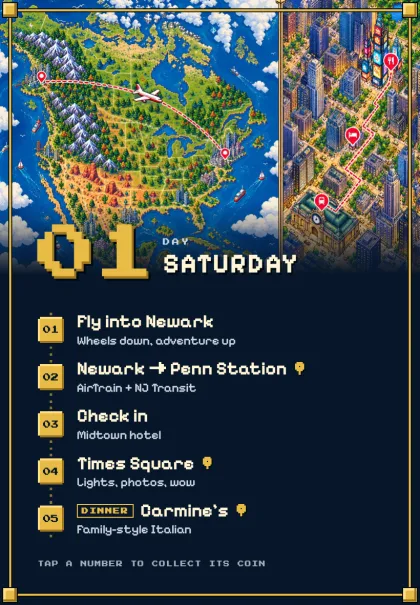
A Play Your Trip book turns every ride into part of the quest: each stop has its own coin, with the subway line and a map link ready on your phone. Play the demo, or start with our first time in NYC tips.
Questions
Do kids pay on the New York subway?
Up to three children under 44 inches tall ride free on the subway and most local buses with a fare-paying adult. Taller children pay the regular fare.
Can I pay for my whole family with one card?
Yes, you can tap the same card for each rider, but only your own first tap counts toward the weekly fare cap. Giving each paying rider their own card or phone is usually cheaper over a week.
Can you take a stroller on the NYC subway?
Yes. Fold it and carry your child on stairs and escalators, use elevators where they exist, and check the MTA's elevator status before you go, because many stations have stairs only.
Is the subway safe for kids?
Millions of New Yorkers, including families, ride it every day. Stand back from the platform edge, hold hands, agree a plan in case you get separated, and use the Help Point intercoms if you need staff.