
New York with a Stroller: Subway Elevators, Buses, Museums and Easy Routes
New York's sidewalks and parks are made for strollers. The subway is harder: only about a third of its stations have step-free access, and the ones that do can have an elevator out of order on the day. Families who manage best plan a few step-free routes, use buses and ferries more than they expected, and know which museums want the stroller folded or parked.
Here's what works on wheels, checked on the official sites. Rules change, so check the MTA and each museum before you go.
The short answer
- Bring a light, foldable stroller and a baby carrier. You'll fold the stroller on subway stairs and escalators, on some observation decks and in a few galleries.
- On the subway, plan around accessible stations and check the MTA's elevator status page on the morning you travel.
- Buses are the easy option: every local and Select Bus Service bus is getting a space for one open stroller near the rear door.
- Ferries are stroller-friendly: NYC Ferry boats have stroller spaces, and the free Staten Island Ferry's terminals have elevators.
- The best routes on wheels: Central Park's drives, Hudson River Park's waterfront path, the High Line (with elevators at several entrances) and the Brooklyn Bridge's pedestrian promenade.
The subway: elevators and accessible stations
The MTA's advice is simple: fold strollers and carry children on stairs and escalators, and use elevators where you can. The trouble is that many stations have stairs only. The MTA counted 160 accessible stations in 2026, out of 472, and it adds more each year.
- Find step-free stations on the MTA's accessible stations list or the map's wheelchair symbol. Inside the station, follow the signs with the same symbol to the accessible path.
- Read the notes. Some stations are accessible for only certain lines or one direction (uptown or downtown), so check the line you need, not just the station name.
- Big hubs on the list include Times Sq-42 St, Grand Central-42 St, 34 St-Herald Sq, 34 St-Penn Station, 59 St-Columbus Circle, 34 St-Hudson Yards, Fulton St, WTC Cortlandt and South Ferry.
- Not every museum stop has an elevator. 81 St-Museum of Natural History, under the natural history museum, isn't on the accessible list; plan a bus or a walk from an accessible station instead.
- Check elevator status before you leave on the MTA's Elevator & Escalator Status page, and sign up for its free elevator alerts if you'll ride a lot.
- Use the AutoGate: many accessible stations have a wide gate for riders with strollers, so you don't have to squeeze through a turnstile.
- Board in the middle of the train, where the conductor usually rides, and keep the stroller out of the doorway.
- Avoid the rush hours when you can; a crowded car with an open stroller is hard for everyone.
Buses: the easiest way around with wheels
Buses are slower than the subway but you can roll on, and toddlers get a window view of the city. The MTA has been adding a designated open-stroller space near the rear door of every local and Select Bus Service bus, and expects the whole fleet to have one by the end of 2026. Look for the stroller sticker by the front door.
- One open stroller per bus. If the space is taken, or your stroller doesn't fit, fold it.
- Buckle your child in, put the brakes on once you're in position, keep hold of the stroller while the bus moves, and keep the aisle clear.
- The wheelchair area is separate, at the front of the bus; the stroller space is near the rear door.
- Children under 44 inches tall ride free on the subway and local buses, up to three with each fare-paying adult. See our NYC subway with kids guide for fares and the weekly cap.
Ferries
- NYC Ferry: strollers ride free and each boat has designated stroller spaces, first come, first served. Strollers aren't allowed on the outside decks or the upper deck. The boats and landings were built to accessibility standards, and children under 44 inches ride free with a paying adult.
- Staten Island Ferry: free, and both terminals have elevators and escalators. It passes the Statue of Liberty on the way; see our NYC with toddlers guide for how to fit it into a morning.
- Statue of Liberty ferry: strollers are allowed on the boats and on Liberty and Ellis Islands, but not inside the monument. With pedestal or crown tickets, you leave the stroller in a designated area outside before you go in.
Museum stroller rules
Most of the big museums welcome strollers, with exceptions worth knowing before you arrive. These are the rules on their official sites; check again before your visit, because temporary exhibitions often have their own.
- The Met: strollers and front-facing baby carriers are welcome, but jogging strollers, wagons and oversized strollers aren't, and some exhibitions don't allow strollers at all. The step-free entrance is at Fifth Avenue and 81st Street.
- American Museum of Natural History: strollers are welcome except in the theatres, which have stroller parking. Double strollers usually aren't allowed in the ticketed exhibitions. Use the step-free Rose Center entrance on West 81st Street or the Gilder Center on Columbus Avenue; the main Central Park West entrance has steps.
- MoMA: strollers are welcome, but they can't go on the escalators (use the elevators), and access can be limited in some galleries.
- The Guggenheim: strollers and soft front-facing carriers are allowed, baby backpacks aren't. Take the elevator to the top and roll gently down the spiral ramp, the way the building was designed to be seen.
- 9/11 Memorial & Museum: strollers of any size can go on the outdoor Memorial plaza. In the museum, strollers are allowed in the exhibitions, but jogging and oversized strollers aren't, and they can't be left at the coat check.
- Observation decks: most ask you to fold the stroller for the elevators or on the decks. Our observation decks guide has each one's rule.
Routes that work on wheels
- Central Park: paved drives loop the whole park and are the smoothest stroller route, though they're shared with cyclists and runners and busy on fine weekends. The Central Park Conservancy's Access Map marks which paths are flat, moderate or steep. Strollers aren't allowed on the Reservoir running track, and the woodland trails are unpaved.
- Hudson River Park: a waterfront esplanade along Manhattan's west side, with playgrounds on several piers (including Pier 25 and Pier 51). Flat, with river views the whole way.
- The High Line: the whole park is wheelchair accessible, with elevators at Gansevoort Street, 14th Street, 23rd Street, 30th Street and the Moynihan Connector at 31st Street, plus park-level access at Hudson Yards. Check the elevator status before you go. It's narrow in places, so mornings are easier than sunny afternoons.
- The Brooklyn Bridge: the promenade has been for pedestrians only since cyclists moved to a protected lane on the roadway in 2021. It's still crowded at busy times, so go early, and walk out to the first tower and back if little ones are tired.
Tips from the sidewalk
- Pick the right stroller: a light one that folds with one hand is worth more than a big all-terrain model here. Double strollers are hard in narrow galleries and on buses.
- Keep the carrier handy for stair-only stations and the galleries where strollers must be parked.
- Plan one area a day. Midtown, the Upper West Side, downtown: each is easy to cover on foot with a stroller, and you'll need the subway less.
- Restrooms are scarce: the big museums and the parks' comfort stations are your best bets. Our first time in NYC tips have more.
Make it a game
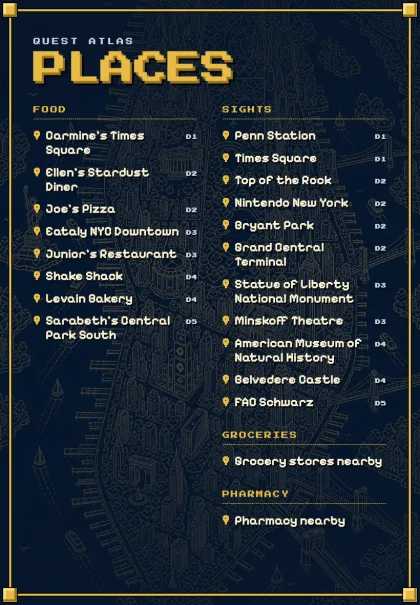
A Play Your Trip book turns your stroller routes into an adventure: every stop a quest with a coin to collect, each one a tap from the map. Make your New York book or play the demo.
Questions
Can you take a stroller on the NYC subway?
Yes. The MTA asks you to fold it and carry your child on stairs and escalators, and to use elevators where you can. Only about a third of stations are accessible, so plan step-free routes and check the elevator status page before you travel.
Do you have to fold a stroller on NYC buses?
Not always. Local and Select Bus Service buses are getting a space for one open stroller near the rear door. Fold it if that space is taken or your stroller doesn't fit.
Which NYC subway stations have elevators?
The MTA's accessible stations list has them all, with notes on which lines and directions are step-free. Big hubs like Times Sq-42 St, Grand Central-42 St, 34 St-Herald Sq and Fulton St are on it.
Are strollers allowed in New York museums?
Mostly, yes. The Met, the American Museum of Natural History, MoMA and the Guggenheim all welcome strollers, but each has exceptions, such as no jogging strollers, no strollers on escalators or in some exhibitions. Check each museum's site before you go.